2 Restoration
2.1 Assessment: understanding the site before intervening
A key first step in peatland restoration is a comprehensive assessment of the site conditions (Quinty & Rochefort, 2003; Schumann & Joosten, 2008b). By monitoring and analyzing the site conditions, restoration practitioners can identify the prominent stressors, quantify their impacts, and develop goals to restore the site. The assessment should describe the current conditions and, if possible, the pre-degraded functioning of the site (Quinty & Rochefort, 2003).
Pre-degradation conditions
Determining pre-degradation conditions of a peatland provides an idea of the undisturbed functioning of the site. Knowing the site’s undegraded condition allows restorationists to set targets and determine how restoration can be evaluated. In general, pre-degradation information can be derived from two sources: Palaeoecology - micro and macro-fossils found in the peat can be used to reconstruct historic ecological interactions between biota and the respective environments (Birks, 2008) Historical records - maps, satellite images, photos, taxonomic collections, and written and oral accounts can provide insight into the historical functioning of the site (Gann et al., 2019b; Quinty & Rochefort, s.d.; Schumann & Joosten, 2008b).
There are several limitations with acquiring and interpreting this information. First, there is often minimal information on the historical conditions of peatlands. This is especially true in areas with long histories of anthropogenic land-use change (e.g., Central Europe), making it difficult to acquire an accurate idea of the original peatland functioning (Gorham & Rochefort, 2003). If information is available, the pre-degraded state may no longer be achievable. For example, soil conditions in extracted peatlands often differ significantly from the original conditions, making rewetting an unviable restoration option (Eiseltová, 2010). Restoration should therefore focus not on restoring historical conditions, but rather on using knowledge of these conditions to restore the achievable function of the peatland (Lamers et al., 2015).
Current conditions
Determining the current conditions of a degraded peatland requires an assessment of three key components: hydrology, peat, and vegetation. These variables are interdependent, meaning a change in one causes a change in the other two (Convention on Wetlands, 2021; Minayeva et al., 2017). The hydrology influences which plants will grow; the plants, in turn, determine the type of peat that forms; and the structure and type of peat regulates the flow and storage of water in the peatland (Schumann & Joosten, 2008b). By assessing each of these components, restoration practitioners can determine the extent to which the peatland is degraded and develop clear and achievable restoration goals.
Figure . Interrelations between plants, water and peat in a mire. Generated by Gemini (Google) on May 5, 2026, adapted from Joosten in Convention on Wetlands, 2021).
Hydrology
Altered hydrology is the primary problem to address in peatland restoration, and thus the most important step in assessing a degraded peatland (Convention on Wetlands, 2021; Päivänen & International Peat Society, 2004). Key parameters to measure are the water table level and water table fluctuations throughout the site (Convention on Wetlands, 2021; Schumann & Joosten, 2008b), as these characteristics determine the status of the peat layer and the vegetation on-site (Pakalne et al., 2021b). The hydrology assessment should also record the amount and type of precipitation, the presence of drainage structures (e.g., ditches, pipes), topography (e.g., slope, microtopography), and the direction of water flow.
The hydrologic regime of peatlands is rarely isolated from the surrounding area. External factors, like upslope agricultural areas with drainage tiles or irrigation lines, can disrupt the groundwater influx to the peatland. Any hydrological restoration to the degraded peatland will be ineffective unless the off-site issues are addressed. Hydrological assessments should therefore incorporate the greater catchment area, including land-use and associated drainage networks (Convention on Wetlands, 2021; Gorham & Rochefort, 2003; Similä et al., 2014b).
Water quality and chemistry parameters (e.g., pH, electrical conductivity) should also be measured, as these conditions influence which plants occur and the peat that accumulates (Parish et al., 2008b). For example, if the groundwater is acidic with a pH < 5, restoring the site towards bog conditions is more realistic and feasible than towards fen conditions (Quinty & Rochefort, 2003). These parameters should be measured both at the degraded site and, for groundwater-fed peatlands (i.e., fens, swamps), at the groundwater source.
Peat
An assessment of the peatlayer is important, as it provides insight into the peatland functioning and what restoration options can improve this function. Thin decomposed peat layers, associated with drained peatlands, have a lower water storage capacity, making the establishment of water-reliant species such as Sphagnum mosses less likely (Quinty & Rochefort, 2003). Further, decomposition can reduce the distance between the sub-peat soil and the surface layer, favouring the establishment of non-peatland plant species. By measuring peat parameters, restoration practitioners can determine the level of degradation and the feasibility of different restoration options (e.g., re-establishing the Sphagnum community). Important peat parameters to measure include the degree of decomposition (using the Von Post scale; see Box X), water content, surface level changes, and peat erosion (Thom et al., 2019b)
In addition to physical properties of peat, chemical analysis of nutrient concentrations can provide further insight into peatland functioning. Degraded peatlands near agricultural areas are often extremely nutrient-rich, due to peat mineralisation, use of chemical fertilisers, and manure from livestock (Convention on Wetlands, 2021). Rewetting of a nutrient-rich peatland can cause internal eutrophication, a process in which anoxic conditions associated with the high water table lead to the mobilisation of nutrients bound to the peat layer (Lamers et al., 2015), favouring the establishment of fast-growing, non-peatland plant species (Convention on Wetlands, 2021). Nutrient analysis should incorporate the greater catchment area to determine if external nutrient enrichment will continue.
Vegetation
A vegetation assessment provides further insight into the peatland condition and function. As it is generally not feasible to conduct an inventory of all plants on site, indicator species are often monitored to obtain a representative assessment of the peatland vegetation with less sampling intensity (Convention on Wetlands, 2021). If indicator species associated with peatlands (e.g., Sphagnum spp. for bogs or Carex spp. for fens) are present, restoration to conditions that support these species is more likely to be achievable. Species associated with drier conditions (e.g., ericaceous shrubs) indicate a disruption of the water table (Bufkova et al., 2021). If invasive species are present (e.g., Spiraea tomentosa, an invasive species that threatens bog communities in Europe (Dajdok et al., 2011)), restoration decisions should incorporate management of these species.
In addition to on-site vegetation, the viability and composition of the seed bank should be monitored to understand the potential of natural vegetation following restoration (i.e., rewetting) (Convention on Wetlands, 2021). If the seed bank on site is not viable, supplementary vegetation management will likely be required as a part of the restoration plan. The assessment of live vegetation and the seedbank should incorporate the degraded peatland and the larger area. For example, if invasive species are identified off-site, their potential impact on restoration should be considered. Additionally, desirable vegetation and seed banks in the surrounding area can serve as donor material for restoration that requires planting or sowing of seeds (Quinty & Rochefort, 2003).
Assessment integration: identifying stressors and degradation level
The data collected during the assessment of site conditions can be compiled and analysed to determine the primary stressors, their negative effects on peatland functioning, and ultimately the level of degradation on-site. Degraded peatlands are often impacted by multiple, interacting stressors. For example, agricultural land use can lead to drainage of peatlands and nutrient enrichment, each requiring different considerations during restoration.
When evaluating the impact of stressors, it is important to consider that peat, hydrology, and vegetation react to degradation at different rates (Convention on Wetlands, 2021). In a drained peatland, hydrology and vegetation experience immediate impacts, with aquatic plant species being unable to survive in the dry conditions, while peat decomposes slowly with less immediate impacts. Considering the differing responses of peat, hydrology, and vegetation to different stressors during the site assessment provides practitioners with the necessary information to begin the restoration planning process.
The Von Post Scale The Von Post scale is a 10-step system forfor classifying peat decomposition, from H1 (completely undecomposed, intact plant structure) to H10 (fully decomposed, no identifiable plant structure). The test involves hand-squeezing a peat sample and observing the colour, turbidity, and texture of extruded water and the remaining material. As peat condition is generally a good indicator of peatland health, due to its interdependence with water and vegetation (Bonnett et al., 2009b), the level of decomposition serves as a reliable proxy for peatland condition. For a simplified version of the Von-Post scale see Figure X.
Table x. Stressors, associated land uses, and impacts affecting degraded peatland sites.
2.2 Planning and design
Upon identification of the stressors affecting a peatland and their extent, restoration planning can begin. This is a critical phase, as it defines the project vision, while identifying potential problems and conflicts that might be encountered along the way (Gann et al., 2019b; Mackin et al., 2017b; Quinty & Rochefort, 2003). Developing a restoration plan is a complex process, requiring engagement with stakeholders, definition of clear goals and objectives, prioritization of restoration options, and effective baseline data. Incorporating these components into the planning phase sets the stage for effective peatland restoration.
2.4 Monitoring and evaluation
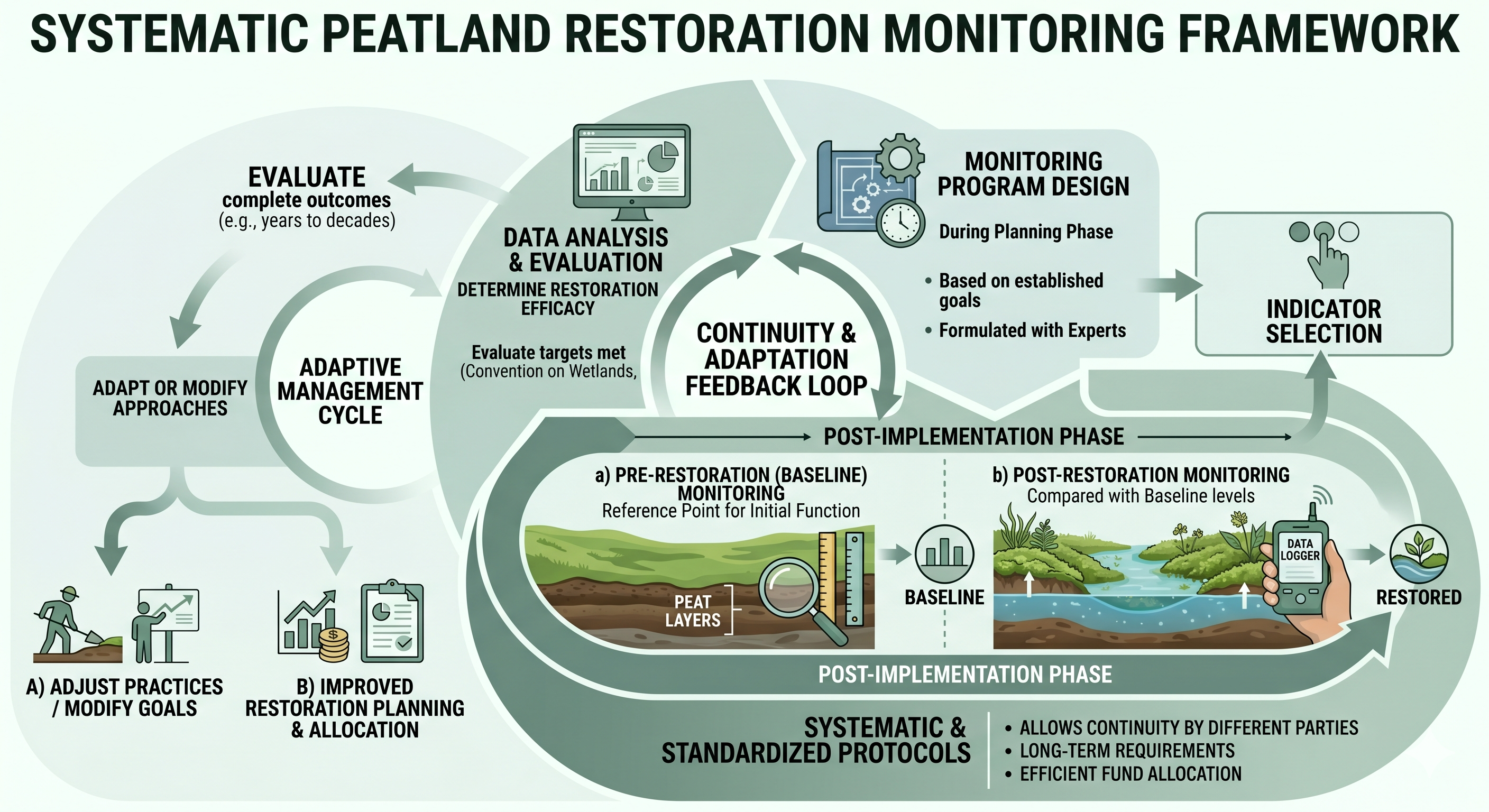
Monitoring plays a crucial role in the post-implementation phase of restoration projects, as it serves to determine whether restoration targets have been met. Without a comprehensive monitoring plan, it is not possible to conclude the effectiveness of restoration, as there is no point of comparison between the restored peatland and the desired conditions. By developing a robust monitoring plan, restoration practitioners can determine the efficacy of treatments and adapt or modify approaches to better achieve the desired outcomes. This could include, for example, adjusting management practices or modifying the project goals and objectives. Monitoring also helps determine whether funds were spent effectively, allowing for improved restoration planning and funding allocation in future projects.
Monitoring design
The monitoring program should be designed during the planning phase, before any restoration treatments are implemented, and should be based on established goals to ensure monitoring parameters are effective indicators of restoration efficacy. For example, a project intended to increase biodiversity or the presence of endangered peatland species will have different indicators than one aimed at GHG reduction. To further ensure that monitoring parameters are appropriately defined, protocols should be formulated through consultation with experts and utilize scientifically supported methods. While some desired outcomes of peatland restoration are immediate (e.g., changing the water table level), others (e.g., re-establishment of a functioning peat-forming ecosystem) may take years to decades. Long-term monitoring may be required to evaluate the complete outcomes of restoration treatments. Due to these long-term requirements, protocols should be systematic and standardized to allow for continuity of monitoring by different individuals and parties, as responsibilities are likely to change throughout the restoration process.
Typically, monitoring is divided into two phases: pre-restoration and post-restoration monitoring. Pre-restoration, or baseline monitoring, occurs before restoration treatments to serve as a reference point for the initial site’s functioning and is a foundational component of the monitoring plan. Post-restoration monitoring occurs after restoration treatments and is compared with baseline levels to determine the extent to which restoration targets are being reached.
Experimental design To allow for effective evaluation of restoration impacts, monitoring plans should follow an experimental design. A standard experimental design for monitoring ecological restoration projects is the Before-After Control-Impact (BACI) protocol. In a BACI design, monitoring indicators are measured before and after restoration treatments on the restoration site, and at a control site with no treatments. This provides two points of reference: the pre-restoration baseline (how the site functioned before restoration) and the control site trajectory (separating observed restoration effects from natural variability). BACI designs should have adequate spatial replication at the restoration and control sites to allow for a more robust determination of restoration impacts by separating them from other effects.
Monitoring parameters Peatland restoration monitoring parameters depend on various factors, including the peatland status and associated goals or the available financial and technical resources. These factors, in combination with the multitude of potential monitoring parameters, make monitoring programs highly project-specific. To address the ambiguity involved in selecting appropriate monitoring indicators, the European Commission, Directorate-General for Environment have provided recommendations for harmonized peatland monitoring protocols (Šefferová Stanová, 2025). Although these parameters and protocols were developed for assessing peatland condition generally, they still serve as relevant indicators for measuring the efficacy of restoration. For a list of mandatory parameters directly relevant to peatland restoration, see Table x.
Table X. Examples of mandatory monitoring parameters for assessing peatland condition, based on (Šefferová Stanová, 2025). Only those identified as directly relevant for peatland restoration monitoring were included.
| Category | Parameter | Method or Tool for Monitoring |
|---|---|---|
| Abiotic | Water table depth and fluctuation | Dipwells, dataloggers with barometers |
| Soil and water pH | pH probes | |
| Soil and water electrical conductivity (EC) | EC meters | |
| Biotic | Vascular plant and bryophyte composition | Vegetation surveys; comparison with standardized habitat type species lists |
| Positive and negative indicator species | Vegetation surveys | |
| Cover of bryophytes, herbs, scrub, trees, and nitrogen indicators, and neophytes | Vegetation surveys, orthophotos |
In addition to these indicators, the restoration treatments should be monitored to ensure proper functioning. As treatments for restoring peatlands primarily aim to achieve rewetting, monitoring the function of restoration treatments often involves assessing the condition of water control structures (e.g., dams, bunds).
As monitoring is dependent on the project budget, restoration practitioners should consider the long-term costs of desired monitoring techniques. Low-budget restoration projects should use low-cost techniques to enable effective monitoring. Projects with larger budgets can consider higher-cost monitoring techniques, provided they are beneficial for evaluating restoration outcomes. Examples of low and high-cost monitoring techniques are shown in Table X. As incorporating replicates increases monitoring costs, the optimal number of replicates should balance maximal benefits and minimal costs.
Table X. High-cost and low-cost monitoring techniques often used in peatland restoration.
| Monitoring Cost | Examples of Monitoring Techniques |
|---|---|
| Low cost | Aerial imagery |
| Dipwells | |
| Proxies of GHG | |
| Field probes | |
| Subsidence poles and pins | |
| Fixed point photography | |
| Vegetation quadrats | |
| High cost | LiDAR |
| Automatic data loggers | |
| Water chemistry and gas chromatograph laboratory analysis | |
| Hydrologic modeling | |
| Eddy Covariance towers for GHG data |
Monitoring considerations The timing of monitoring can, for some parameters, significantly alter the results. For example, if groundwater discharge has been identified as an indicator parameter, measurements should be taken when conditions are dry. Thus, consideration should be given to the temporal influence on the variability of monitoring data.
This webpage is not intended to be an exhaustive list of all monitoring techniques for restoration, but rather to inform restoration practitioners of key concepts to consider when designing a monitoring plan. Consideration of these factors will allow for more effective evaluation of peatland restoration. For more comprehensive documents outlining specific monitoring parameters and protocols, see Šefferová Stanová (2025).
Data collection
Monitoring is the basis for determining whether restoration targets have been reached. Thus the data collected during this process is critical to ensure reliable conclusions can be made. Methods for data collection should be clearly outlined in the monitoring plan and follow standardized and systematic protocols to ensure quality assurance and standards are upheld throughout the data collection process. Having well-defined protocols can allow for easy training of monitoring responsibilities throughout the restoration project and help prevent against observation bias. Equally important to well-defined protocols and training for data collection is developing an extensive data management plan to ensure the collected data can effectively support the evaluation process. A data management plan should cover file formats and structures, and outline file backup and data redundancy protocols. Ensuring that data is collected and managed according to pre-established protocols will contribute to effective long-term project evaluation.
Evaluation
The data collected during monitoring are analyzed to determine the extent to which restoration targets are being reached by comparing post-restoration conditions with pre-restoration conditions, control-site conditions, and/or reference-model conditions. Šefferová Stanová (2025) recommends using the distance from the reference condition as a measure of restoration success. The distance from the reference condition is defined as the difference between a variable’s measured value and its reference level (i.e., the desired value established during the planning phase). This framework provides tangible values that restoration practitioners can use to determine the efficacy of restoration efforts.
Another widely used technique for evaluating restoration outcomes is the 5-star system paired with the ecological recovery wheel, recommended by Gann et al. (2019). These tools provide a systematic framework for comparing site conditions to a reference model to assess the effectiveness of restoration. Note that the 5-star system and the Ecological Recovery Wheel should be adapted to the respective restoration project.
Determining how well targets were met allows practitioners to assess the efficacy of restoration, and whether funding was well spent. Determining which treatments were or were not effective will enable enhanced selection of restoration treatments in future projects, leading to more effective spending. In addition to evaluating the impacts of restoration, the monitoring plan and protocols should also be assessed. Restoration practitioners should consider whether monitoring is providing the information required to evaluate restoration impacts to determine whether technical adjustments to the monitoring program are required to assess restoration outcomes more effectively. The outcomes of the restoration treatment evaluation will determine whether management interventions are needed.
2.5 Ongoing Management
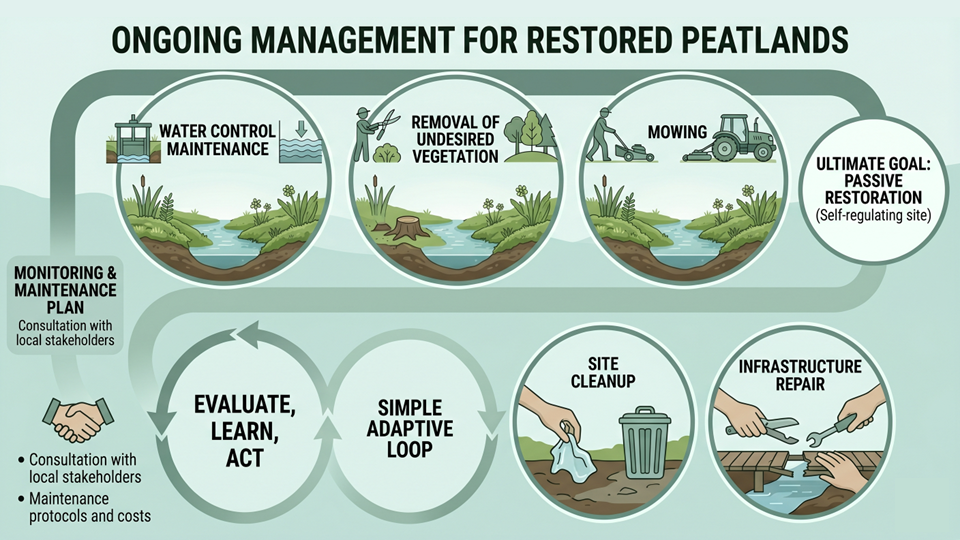
Restored peatlands, like most restoration sites, will often require some level of ongoing management after treatments to prevent the site from regressing into a degraded state. The level of ongoing management required will depend on various factors, including the characteristics of the restoration site, the present stressors, and the available funding. Ongoing management can include either pre-scheduled preventative maintenance or adaptive management, which is determined based on the monitoring results.
Management Activities
Preventative Maintenance
Preventative maintenance activities are pre-scheduled interventions aimed at preventing the site from slipping into a degraded state. They should be included in the monitoring and maintenance plan, which is developed through consultation with local stakeholders. Maintenance protocols and costs should also be outlined in this plan. Examples include:
- Maintenance of water control structures to ensure appropriate water levels are maintained on-site.
- Removal of undesired vegetation to encourage the establishment and succession of desired peatland species. The removal of encroaching trees and shrubs can be beneficial for short-term restoration when rewetting has not been successful due to drought. However, removal of encroaching shrubs and trees has also been linked to increased seedlings in the cleared area due to the greater light availability and the surface peat acting as an effective germination medium.
- Mowing to assist with the regrowth of peatland specialist species while suppressing the growth of other dominant, undesired species. Worth noting, mowing with large machinery can also reduce habitat heterogeneity of restored peatlands by destroying microtopography, leading to losses of rare species that require heterogeneity.
The above examples of preventative maintenance illustrate the complexity of peatland management, with no consistent management protocols applying to all restoration projects. Preventative management techniques should be carefully selected with the ultimate goal of establishing passive restoration, in which the natural conditions are restored and the site becomes self-regulating.
Adaptive Management
Adaptive management is the process of evaluating information gained during monitoring to continuously work towards desired restoration outcomes by employing new management techniques. When monitoring indicates that the restoration trajectory is deviating from targets, adaptive management serves as a framework to determine the best course of action to achieve restoration targets. This process supports restoration while simultaneously gaining insight into the efficacy of various restoration treatment and management techniques.
In the Kuivaniemi Lähteenaapa swamp restoration project (Finland), wet conditions prevented large machinery from accessing much of the site for restoration treatments (e.g., digging ditches, constructing dams). To offset the requirement for machinery, the construction of dams was done manually instead. Monitoring results indicated that the restoration trajectory was not proceeding as desired, so the practitioners entered the site in the winter, when the ground was frozen, to construct new, mechanically-built dams. This adaptive management resulted in improved restoration outcomes on-site.