1.1 Peatlands, fens, bogs, mires, and wetlands: what’s in a name?
European peatland science uses a precise vocabulary that does not always map neatly onto everyday language. Using terms consistently is essential for project documentation, regulatory compliance, and cross-border collaboration. In this section, we clarify key distinctions between terms such as peatlands, fens, bogs, mires, and wetlands to support a shared understanding.
Wetlands
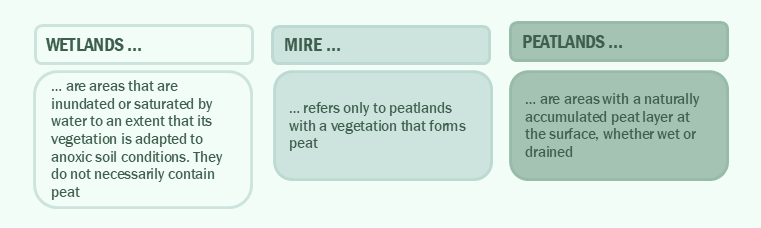
A wetland is an area that is inundated or saturated by water at a frequency and duration sufficient to support a prevalence of vegetation typically adapted for life in saturated soil conditions.[1] These areas are natural or artificial, permanent or temporary, with water that is static or flowing, fresh, brackish or salt, including areas of marine water the depth of which at low tide does not exceed six metres.
They include a wide variety of inland habitats such as marshes, wet grasslands, peatlands, floodplains, rivers and lakes, coastal areas such as saltmarshes, mangroves, intertidal mudflats and seagrass beds, and coral reefs and other marine areas, as well as human-made wetlands such as dams, reservoirs, rice paddies and wastewater treatment ponds and lagoons.[2]
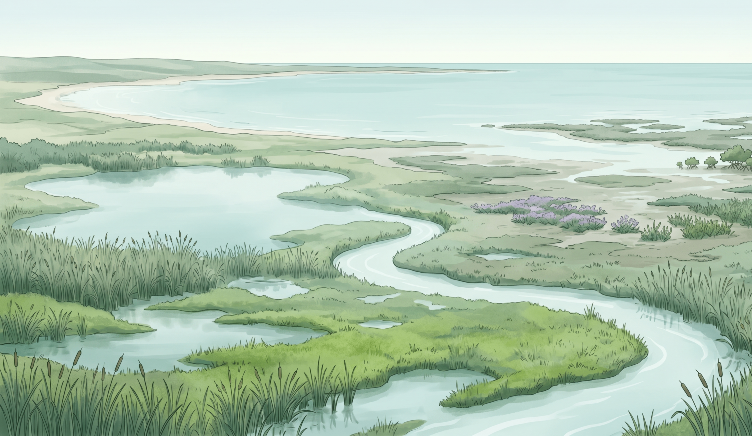
Three attributes define a wetland and determine which type it is: its hydrology (degree of inundation and soil saturation), its vegetation (plant communities adapted to anoxic conditions), and its soils (particularly the tendency to accumulate organic material when decomposition is suppressed by waterlogging).
Peat and peatlands
Peatlands are wetland ecosystems where soils are dominated by peat. In peatlands, net primary production exceeds organic matter decomposition as a result of waterlogged conditions, which leads to the accumulation of peat.[3]
Peatland conservation is widely recognised internationally as an important nature-based strategy for climate change mitigation. However, there is still no universally agreed definition of “
peat Soft, porous or compressed, sedimentary deposit of plant origin with high water content in the natural state (up to about 90%). Countries may define peat according to their national circumstances. “, which creates challenges for estimating and comparing global peat carbon storage.
As this website is built for restoration and conservation purposes, Lourenco et al. (2023)[4] proposes — in accordance with the recommendations from the IPCC working groups and FAO[5],[6] — that a peatland can be defined as an area containing peat soil having at least 5% organic carbon through a depth of at least 0.1 m. At the time of identification, the peatland can be with or without vegetation and be either waterlogged or not waterlogged.
A peatland that is actively forming new peat is called a mire.[1]
Peat composition and types
The botanical origin of the plant material governs peat chemistry and structure, and directly determines which restoration targets are achievable on a given site:
- Sphagnum peat — dominated by Sphagnum mosses; highly absorbent; characteristic of nutrient-poor, acidic conditions, for instance in bogs.
- Sedge peat — dominated by sedges (Carex spp.); often found in fens.
- Reed peat — formed in reedbeds, often in eutrophic swamp systems.
- Forest peat — derived from needles, leaves, and woody debris mixed with other plant material in wet forest environments; composition varies with tree species.
Peat profiles are rarely uniform: successive layers of different peat materials, sometimes interspersed with mineral layers, reflect long-term changes in hydrology, vegetation, and climate.
Classifying mires and peatlands
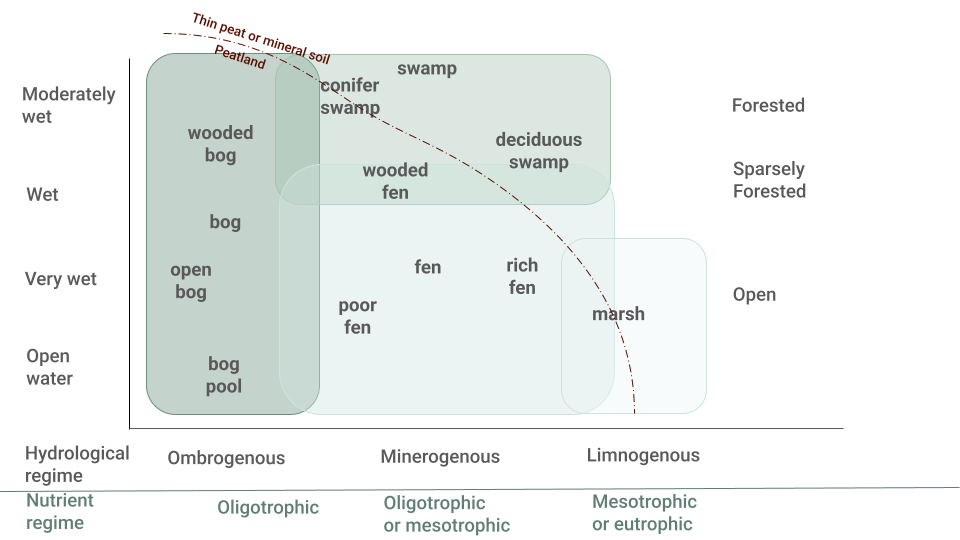
Mires and peatlands can be classified using a combination of hydrological and chemical criteria. The two most important environmental gradients — wetness (distance between the vegetation surface and the water table) and the trophic-mineral gradient (a compound of pH, base saturation, and nutrient status) — define the position of broad wetland types in ordination space (Figure 3; adapted from Rydin & Jeglum, 2013[7]).
Ombrogenous vs. minerogenous
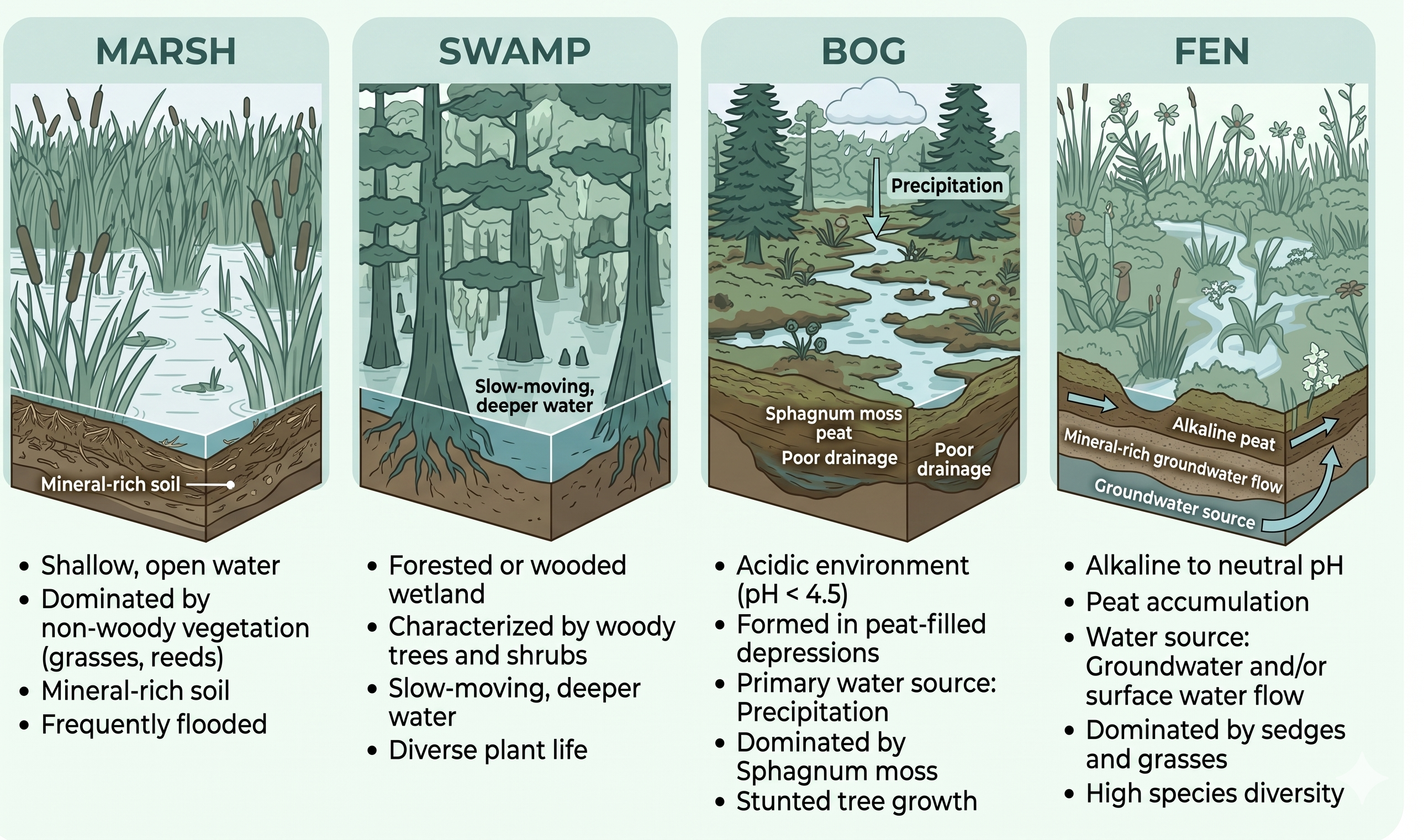
Bogs are peatlands receiving water and nutrients exclusively from atmospheric precipitation — they are ombrogenous and typically acidic and nutrient-poor. Fens are peatlands receiving additional groundwater or surface-water inputs — they are minerogenous and span a wide range of pH and nutrient conditions. This distinction is fundamental to restoration planning: the water source determines both the attainable vegetation community and the appropriate restoration technique.
Marshes are wetlands characterized by emergent soft-stemmed vegetation receiving most of their water from surface water, and many marshes are also fed by groundwater. Nutrients are abundant. Swamps are wetlands dominated by woody plants characterized by saturated soils during the growing season and standing water during certain times of the year. The highly organic soils of swamps form a thick, black, nutrient-rich environment for the growth of water-tolerant trees.
1.2 Why peatland restoration?
Peatland restoration is the assisted recovery of a degraded, damaged, or destroyed peatland ecosystem. It aims to return peatland structure, species composition and ecological processes to a naturally functioning, self-sustaining state.[8],[7],[9] Peatland restoration is important for three key reasons: stabilizing the climate, conserving biodiversity, and supporting a wide range of ecosystem services. To prevent further peat decomposition, soil subsidence and CO2 emissions from peatlands, peatland restoration always requires full rewetting by raising the water level to near the surface.[10]
Climate stabilisation
Peatlands are the most efficient long-term carbon reservoirs of all ecosystems, retaining carbon over extended timescales.[2] They are also the dominant wetland type globally, comprising around 50–70% of all wetlands. Despite covering a relatively small portion of the Earth’s surface, they hold approximately one-third of global soil carbon and contain about 10% of the world’s freshwater resources.[1]
Peatlands are being degraded by drainage, fires, atmospheric deposition, and extraction. These activities include use for fuel and horticulture. As a result, peatlands are becoming a growing source of human-caused greenhouse gas emissions.[11]
When peatlands are degraded they can shift from storing carbon to emitting it, releasing carbon that has accumulated over centuries back into the atmosphere. Restoring peatlands is recognised as a key GHG mitigation measure. Conserving and restoring peatlands is considered critical for meeting international climate targets, such as the Paris Agreement, as emissions from drained peatlands consume a significant portion of the remaining global carbon budget.[12],[13]
Biodiversity conservation
Peatlands support distinctive and often highly specialised communities of plants, invertebrates, birds, and other organisms. The majority of European peatland habitat types are classified as “vulnerable” or “endangered” on the EUNIS habitat red list. [14] Palsas — a unique periglacial landform found in the discontinuous and sporadic permafrost zones of northern Europe — are listed as critically endangered. Restoring peatland hydrology and vegetation directly supports the recovery of these communities and their associated species.
European peatland habitats are protected under both the Habitats Directive and the Birds Directive, and are subject to binding restoration targets under the Nature Restoration Regulation (NRR). Restoration is therefore not only ecologically justified — in many contexts it is a legal obligation.
Ecosystem services
Beyond carbon storage and biodiversity, peatlands provide a range of regulating and cultural services: water purification, flood attenuation, baseflow maintenance, and cultural landscape value. Economic analyses suggest that every euro invested in wetland restoration generates €8–38 in economic value through enhanced ecosystem services (IEEP policy brief; reference to be verified). A Cost–Benefit Analysis (CBA) — assigning monetary values to these benefits relative to restoration costs — can be a useful tool for securing private landowner support.
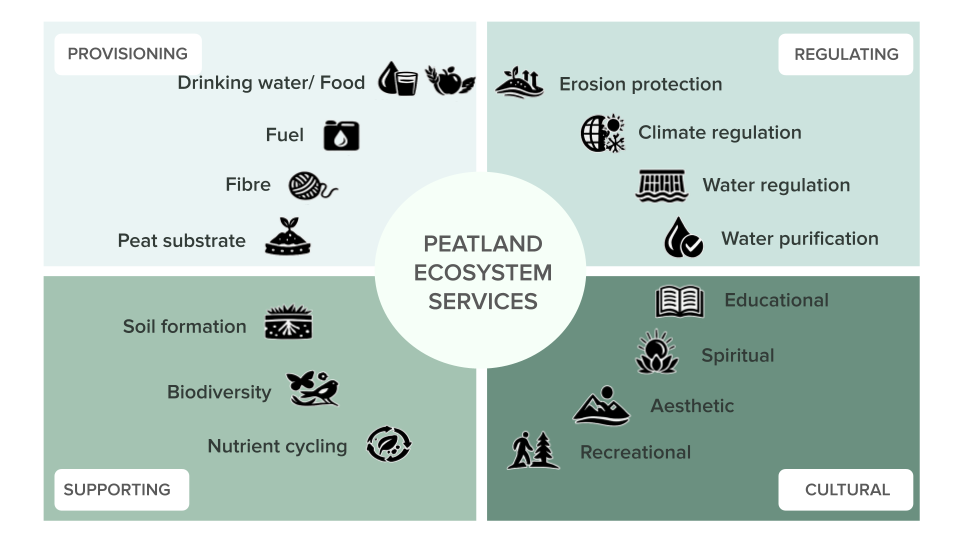
Ecosystem services are the ecological processes or functions that generate value for people or society. They are conventionally categorised as:
- Regulating services — climate regulation, flood control, water purification
- Provisioning services — water supply, biomass (e.g. paludiculture)
- Cultural services — recreation, landscape, heritage
- Supporting services — soil formation, nutrient cycling
1.3 Political Landscape of Peatland Protection
Peatlands are central to achieving the targets of several EU sectoral policies. Notable EU legislations include the Common Agricultural Policy (CAP); EU Land use, land use change and forestry (LULUCF) regulation under the Fit for 55 Climate Package; Water Framework Directive (WFD); Habitats and Birds Directives; Nature Restoration Regulation (NRR); and a potential upcoming Carbon Removals and Carbon Farming Certification (CRCF).[16]
The following chapters will provide an overview of the key legislation relating to the restoration of peatlands and associated funding mechanisms. More detailed information on individual funding instruments can be found in Annex X, along with a decision support system for landowners and practitioners within the European Union interested in rewetting their peatland and accessing financial support for it.
More detailed information on key European policies governing biodiversity is available via the EU Biodiversity Knowledge Centre.
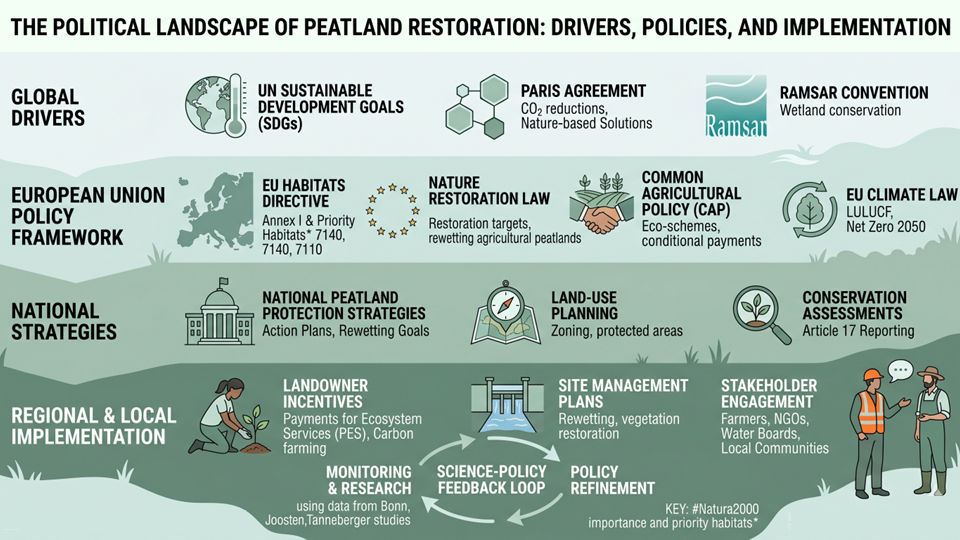
Natura 2000 network: Habitats & Birds Directive
Peatlands are legally protected under the European Union’s Natura 2000 network, which is anchored by the Habitats Directive (92/43/EEC) and the Birds Directive (2009/147/EC). The Habitats Directive specifically designates various peatland types as priority habitats requiring strict conservation measures to prevent degradation, while the Birds Directive safeguards the diverse avian species that rely on these peatlands and wetlands for breeding, feeding, and migration. Together, these legislative frameworks mandate the conservation of wild animal and plant species and natural habitats of Community interest by establishing a coherent network of Natura 2000 sites across the EU.
The mire-related open landscapes are divided into three sub-groups under the Habitats Directive:
Table 1. Raised bogs, mires and fens listed in Annex I of the Habitats Directive.
| Habitat group | Habitats |
|---|---|
| Sphagnum acid bogs | 7110* Active raised bogs i |
|
7120
Degraded raised bogs
i
Degraded raised bogs Raised bogs where there has been disruption to the natural hydrology of the peat body. Read more → |
|
|
7130*
Blanket bogs
i
Blanket bogs Extensive bog communities or landscapes on flat or sloping ground with poor surface drainage. Read more → |
|
|
7140
Transition mires and quaking bogs
i
Transition mires and quaking bogs Peat-forming communities developed in low to moderately nutrient-rich water surfaces. Read more → |
|
|
7150
Depressions on peat substrates of the Rhynchosporion
i
Depressions on peat substrates of the Rhynchosporion Highly constant pioneer communities of the Rhynchosporion on humid exposed peat or sometimes sand. Read more → |
|
|
7160
Fennoscandian mineral-rich springs and spring fens
i
Fennoscandian mineral-rich springs and spring fens Springs and spring fens characterized by continuous flow of groundwater. Read more → |
|
| Calcareous fens |
7210*
Calcareous fens with Cladium mariscus
i
Calcareous fens with Cladium mariscus Cladium mariscus beds of the emergent-plant zones of lakes or fallow lands or succession stage of extensively farmed wet meadows. Read more → |
|
7220*
Petrifying springs with tufa formation
i
Petrifying springs with tufa formation Hard water springs with active formation of travertine or tufa. Read more → |
|
|
7230
Alkaline fens
i
Alkaline fens Wetlands mostly or largely occupied by peat or tufa-producing small sedge and brown moss communities. Read more → |
|
|
7240*
Alpine pioneer formations
i
Alpine pioneer formations Alpine and peri-Alpine communities colonising neutral to slightly acid substrates soaked by cold water. Read more → |
|
| Boreal mires |
7310*
Aapa mires
i
Aapa mires Mire complexes in boreal zones characterised by minerotrophic fen vegetation in the central parts of the complexes. Read more → |
|
7320*
Palsa mires
i
Palsa mires Subarctic mires where the climate is slightly continental and the mean annual temperature is below minus 1 degree Celsius. Read more → |
* Priority habitat type under Annex I of the EU Habitats Directive (92/43/EEC)
Seven of these habitat types are Priority Habitats under Annex I of the Habitats Directive (indicated with an asterisk). For all these habitat types, a clear definition is provided, but member states can have different interpretations that even differ regionally.[17] Habitat type 7140 for instance, has 3 subdivisions in Belgium, related to acidity, nutrient status and mineral composition (7140_oli, 7140_meso, 7140_base). In Germany, federal states use different indicator species for 7140, varying from 7 to 141 plant species.[18]
The majority of peatlands in Europe are fens.[19] Individual mire habitats often occur in complexes with other mire habitat types, making strict separation difficult. Temperature, precipitation and oceanity influence the distribution and variability of peatland types in Europe.[20]
Member States are legally obliged to actively manage and protect Natura 2000 sites, focusing on the preservation and restoration of habitat structure and function. This involves maintaining or achieving a favourable conservation status for each designated habitat, which encompasses not only the essential physical components (structure) and ecological processes (functions), but also a diverse and healthy species composition. Several of these habitats and species occur — partly or exclusively — on peat soils (see Annex 1a and 1b).
Furthermore, Member States must work towards achieving the favourable reference area for each habitat type within the network. A crucial aspect of this management is implementing a landscape-scale approach, acknowledging the interconnectedness of habitats and the importance of connectivity within the wider environment for supporting protected species and overall biodiversity conservation.
Nature Restoration Regulation
On 27 February 2024 the Council of the EU formally adopted the European Nature Restoration Regulation (NRR), setting out legal restoration obligations for terrestrial, coastal, and freshwater ecosystems (Article 4). It covers habitat types listed in Annex I to the NRR, such as wetlands, forests, grasslands, and estuaries. These habitat types correspond to the habitats listed in Annex I of the Habitats Directive, dating back to 1992. Member States shall take the necessary measures to improve the condition of these habitat types (NRR article 4.1).
Phased in over three time spans, the NRR sets binding deadlines and targets for achieving good condition of Annex I habitats:
- At least 30% of the total area of all Annex I habitat types by 2030
- At least 60% by 2040
- At least 90% by 2050
Until 2030, priority should be given to areas located within Natura 2000 sites (NRR article 4.4).[21]
Additionally, NRR Article 11.4 endorses the restoration of organic soils in agricultural use constituting drained peatlands. Restoration measures shall be put in place on:
- At least 30% of drained peatlands by 2030, of which at least a quarter shall be rewetted
- At least 40% by 2040, of which at least a third shall be rewetted
- At least 50% by 2050, of which at least a third shall be rewetted[21]
Common Agricultural Policy
The Common Agricultural Policy (CAP) is the central legislation governing financial support to farmers across the EU, integrating climate and environmental protection into its framework.[22] The CAP consists of two pillars:
- Pillar I focuses on direct payments to farmers, contingent on adherence to a set of basic rules known as conditionality, which includes the ‘Good Agricultural and Environmental Conditions’ (GAECs).
- Pillar II manages payments through the European Agricultural Fund for Rural Development (EAFRD).
Via financial incentives within both pillars of the CAP, drainage-based peatland use is subsidised. In this way, public money supports land use that causes high societal costs and counteracts European and national goals with respect to climate change mitigation, water protection, and biodiversity conservation.[10]
The CAP strongly influences land use practices and is therefore crucial for meeting climate and nature restoration goals. However, it has so far fallen short — particularly in promoting peatland restoration, despite its high potential to reduce greenhouse gas emissions. The CAP 2023–2027 introduces a stronger “green architecture,” including a key objective on climate mitigation, recognition of peatlands and wetlands as carbon-rich soils, and support for paludiculture as a sustainable use of rewetted peatlands.[23]
Water Framework Directive
The Water Framework Directive (2000/60/EC), adopted in 2000, established a comprehensive framework for the protection of all water bodies across Europe, aiming to achieve “good status” for rivers, lakes, groundwater and coastal waters by setting ecological and chemical quality standards.
Even though peatlands are not considered separate water bodies under the WFD, they influence surrounding water bodies and associated river basins hydrologically. Restoring degraded peatlands directly supports the WFD by reversing the pollution and hydrological disruption caused by peatland melioration. Through rewetting and ditch blocking, peatland ecosystems regain their ability to filter pollutants, regulate water flow and sequester carbon, helping Member States achieve the directive’s mandatory “good ecological status” targets.[24]
Carbon Removals and Carbon Farming Regulation
The Carbon Removal and Carbon Farming (CRCF) Regulation is an EU policy initiative aiming to establish a voluntary framework for certifying permanent carbon removals, carbon farming and carbon storage in products. Carbon farming refers to land management practices that enhance carbon sequestration in soils, including forests and agricultural land — and here the connection with peatlands becomes visible.
In order to build an EU-wide robust, comparable, and reliable system for private sector investments into peatland restoration, a standardised EU-level certification shall facilitate sustainable carbon farming solutions without greenwashing. Peatlands are included as a viable pathway for soil emission reductions. The CRCF is intended to be an important step towards accelerating investment in peatland rewetting. The final shape of the CRCF Delegated Act will influence the scale and effectiveness of future investment in peatland rewetting in EU Member States.[16],[25]
- Joosten, H. & Clarke, D. (2002). Wise use of mires and peatlands. Background and principles including a framework for decision-making. International Mire Conservation Group / International Peat Society. ↑ Wetlands ↑ Peat and peatlands ↑ Climate stabilisation
- Ramsar Convention Secretariat (2016). An Introduction to the Ramsar Convention on Wetlands. 7th ed. Ramsar Convention Secretariat, Gland, Switzerland. ↑ Wetlands ↑ Climate stabilisation
- IPCC (2019). Refinement to the 2006 IPCC Guidelines for National Greenhouse Gas Inventories, Calvo Buendia, E., Tanabe, K., Kranjc, A., Baasansuren, J., Fukuda, M., Ngarize, S., Osako, A., Pyrozhenko, Y., Shermanau, P., & Federici, S. (eds). IPCC, Switzerland. ↑ back
- Lourenco M., J.M. Fitchett, S. Woodborne (2023). Peat definitions: a critical review. Prog. Phys. Geogr. Earth Environ., 47 (4), pp. 506_520, 10.1177/03091333221118353. ↑ back
- Intergovernmental Panel on Climate Change IPCC (2014). Switzerland, Intergovernmental Panel on Climate Change. 2013 Supplement to the 2006 IPCC Guidelines for National Greenhouse Gas Inventories: Wetlands. Geneva. Available from: https://www.ipcc-nggip.iges.or.jp/public/wetlands/pdf/Wetlands_Supplement_Entire_Report.pdf (accessed 28 September 2021). ↑ back
- Food and Agriculture Organization (FAO) (2020). Peatlands mapping and monitoring. Recommendations and technical overview. Rome. DOI: 10.4060/ca8200en ↑ back
- Rydin, H., & Jeglum, J. K. (2013). The biology of peatlands (2nd ed.). Oxford University Press. ↑ Classifying mires and peatlands ↑ Why peatland restoration
- Bonnett, S. A. F., Ross, S., Linstead, C., & Maltby, E. (2009). A review of techniques for monitoring the success of peatland restoration. Natural England Commissioned Report, NECR086. Natural England. ↑ back
- Schumann, M., & Joosten, H. (2008). Global peatland restoration: A manual for policy makers and site managers. Institute of Botany and Landscape Ecology, University of Greifswald. ↑ back
- Greifswald Mire Centre (GMC) (2019). Briefing Paper on the role of peatlands in the new European Unions Common Agriculture Policy (CAP). Briefing Paper on the role of peatlands in the new European Unions Common Agriculture Policy (CAP) ↑ Why peatland restoration ↑ Common Agricultural Policy
- Dunn, C., & Freeman, C. (2011). Peatlands: Our greatest source of carbon credits? Carbon Management, 2(3), 289_301. https://doi.org/10.4155/cmt.11.23 ↑ back
- Sommer P., Lakner S., Anke N., Tanneberger F. & Wegmann J. (2024). Deriving a justified budget for peatland rewetting. Applying the German coal phase-out as a blueprint. Land Use Policy. 147. 10.1016/j.landusepol.2024.107363. ↑ back
- Leifeld J., Wüst-Galley C., Page S. (2019). Intact and managed peatland soils as a source and sink of GHGs from 1850 to 2100. Nat. Clim. Chang. 9 (12), 945_947. ↑ back
- Janssen, J. A. M., Rodwell, J. S., Garcia Criado, M., Arts, G. H. P., Bijlsma, R. J., & Schaminee, J. H. J. (2016). European Red List of Habitats: Part 2. Terrestrial and freshwater habitats. European Union. https://doi.org/10.2779/091372 ↑ back
- Peters, J., Kaiser, M., Schoten, Harm, Škunca, Marina & Mróz, Wojciech (2024). Policy Brief: New Developments in European Peatland Strategies. Policy brief: "New Developments in European Peatland Strategies" ↑ Political Landscape ↑ Carbon Removals and Carbon Farming
- Evans, D. (2010). Interpreting the habitats of Annex I: past, present and future. Acta Botanica Gallica, 157(4), 677–686. https://doi.org/10.1080/12538078.2010.10516241 ↑ back
- Joosten, H., Tanneberger, F., & Moen, A. (Eds.). (2017). Mires and peatlands of Europe: Status, distribution and conservation. Schweizerbart Science Publishers. ↑ back
- Tanneberger, F., Moen, A., Barthelmes, A., Lewis, E., Miles, L., Sirin, A., Tegetmeyer, C., & Joosten, H. (2021). Mires in Europe Regional diversity, condition and protection. Diversity, 13(8), 381. https://doi.org/10.3390/d13080381 ↑ back
- Šefferová Stanová, V. (2025). Mires: bogs and fens. In: C. Olmeda & V. Šefferová Stanová (eds.), Technical guidelines for assessing and monitoring the condition of Annex I habitat types of the Directive 92/43/EEC. Luxembourg: Publications Office of the European Union, ISBN 978-92-68-32008-2. https://doi.org/10.2779/2320274 ↑ back
- ALFAwetlands (2024). Policy Brief. Restoring wetlands in Europe. English_Policy-Brief_incl.-all-CFS_online_komp_corrected.pdf ↑ NRR — habitat targets ↑ NRR — peatland targets
- ELO (European Landowners Organisation) (2025). Farming (in) Peatlands. https://www.euki.de/peatland-manuals-and-dialogue-for-climate-action/ ↑ back
- Wichmann, S. (2026). Funding for peatlands and paludiculture within and beyond the EU CAP 2023-2027. EU Horizon Project Socio-economic and Climate and Environmental Aspects of Paludiculture (Paludi4All). Paludi4All Deliverable 4.1., Version 1, 77 pp. ↑ back
- European Environment Agency (EEA) (2019). The European environment – State and outlook 2020. Knowledge for transition to a sustainable Europe Publications Office, https://data.europa.eu/doi/10.2800/96749 ↑ back
- Wetlands International (2026). Wetlands in the Carbon Removals and Carbon Farming regulation. Where we are and what comes next. Available online: Wetlands in the Carbon Removals and Carbon Farming regulation_Wetlands International Europe ↑ back